

Alternative Hair Donor Sources
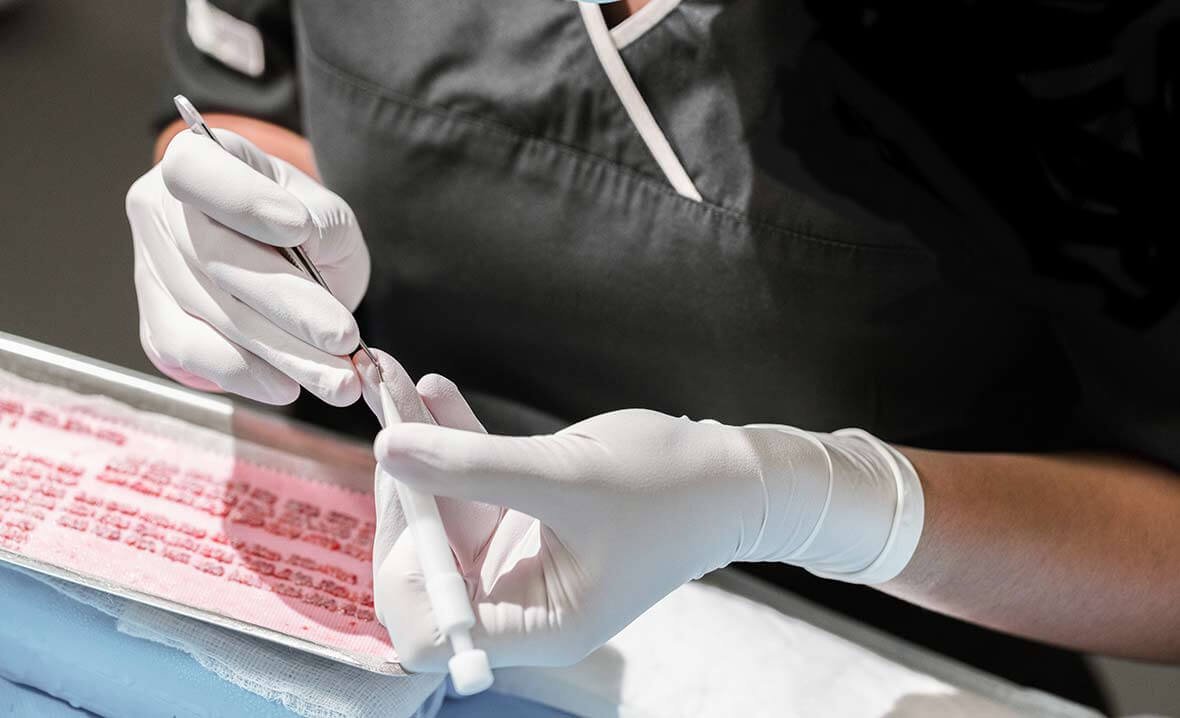
As FUE leaves behind no linear scars, it is more suitable to harvest from various body areas including beard, chest, and extremities in hirsute individuals. Body hair characteristics such as thickness, length, and hair cycle may not completely match to that of the scalp hair. The techniques of harvesting body hairs are more time consuming, requiring higher degree of skill than regular scalp FUE. The extracted body hair can be used successfully, either alone or in combination with scalp hair in advanced grades of baldness, for improving the cosmetic appearance of hairlines and in scarring alopecia, when there is paucity of donor scalp hair.The beard and chest are the two most common alternative hair donor sources.
BEARD FOLLICLES
Recovery period (after the extraction) is from 3 to 7 days. Since the extracted hair does not grow again on the beard area, a thinning may be seen after the procedure.
If the thinning after extraction is only the 20-30% of the available donor area, it does not leave any visible gaps to your beard.
Since beard follicles are simillar, but still different in structure, they are not used in front hair lines. However, they give very good results in the middle and top area of the head.
CHEST FOLLICLES
The extracted grafts from the chest area are thinner and shorter than those in the beard and the scalp. They are usually combined with scalp hair follicles, in order to increase the density of the bald area and keep the natural growth of the hair follicles. However, the survival rate of the extracted follicles from the chest area is lower than the ones from scalp and beard, so it’s not the optimal solution for a successful implantation procedure.
As mentioned before, both the beard and chest area is used only when there is paucity of donor scalp hair. It is not recommended in other cases. In this image, you can see follicles from different body areas with a description of their quality:
Scalp hair grafts have longer intradermal course and one can easily harvest follicular units having three or four follicles to enhance the optical density. (b) Beard hair grafts are thicker with shorter intradermal course as compared to scalp hairs. Note few follicular units have two or three follicles per unit. (c) Pubic hair grafts appear thick and have a short, curved intradermal course compared to scalp hair grafts. Such grafts require a wider punch or manual needle follicular unit extraction (FUE) to reduce graft transection. (note a few follicular units having two follicles per graft). (d) Axillary hair grafts harvested by follicular unit transplant (FUT) method. (FUT is easier for axillary hairs because of the difficult to access location for doing FUE and resultant scar can be hidden in the axillary folds).
Planning should include identification of the donor hair sources, understanding approximately how many grafts are needed from each source, and knowing where and how the donor source hair will be transplanted. It is generally preferable to mix hair from different donor sources in the recipient site to create a blended look, which is aesthetically more pleasing than look that could result from grafting islands of non-mixed body hairs. The characteristics of the recipient body hair have to match the donor hair, taking into account hair diameter, color, curliness, typical rate of growth, and shaft angle.
Our highly skilled medical staff, has successfully completed many hair transplantation surgeries using “Combination Grafting” of scalp and body hair to enhance the visual density of hair transplant and coverage of higher grade of baldness.
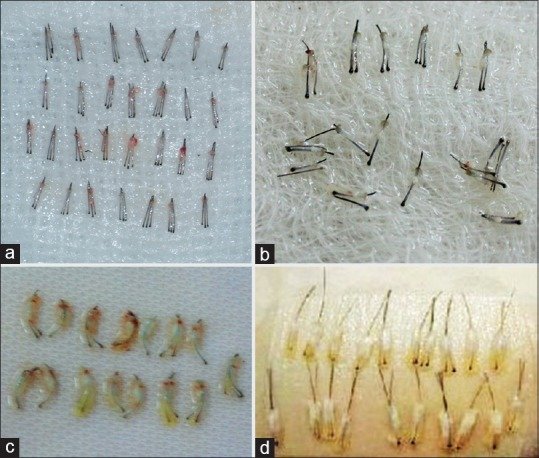
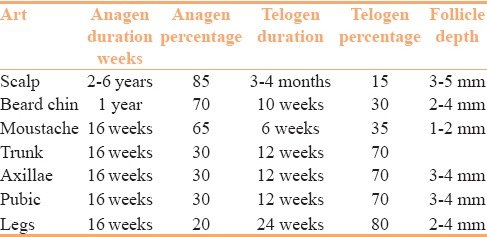
Table 1 – Details about hair cycle duration and follicle depth at different body sites
FOR FURTHER INFORMATION, CONTACT US VIA EMAIL OR WHATSAPP.